
Emerging Trends for 2026
January 27, 2026 | 12 minute read
Written by Arti Jalan
2026 might be off to a bit of a swirly start, but this year of the Fire Horse carries an unmistakable charge: boldness, unfiltered truth, and a sense of necessary disruption. Habits, systems, routines, and familiar ways of moving that have been running on auto-pilot will be asked to be examined rather than repeated, and we’ll be leaning into collective autonomy, creative expression, and forms of connection that can be sensed, touched, and actually lived.
These are some of the things that I believe will begin gaining momentum this year, pulled from my lived experience and pattern-noticing practice, as well as insights from the collective consciousness.
When it comes to trends, predictions, and thinking ahead to our emerging futures, I love delving into what I call Intuitive Forecasting. Noticing clues in the world around me, as well as the way I’m feeling within myself is how I pick up threads that weave themselves into recognizable patterns. I think of this work as cultural cartography rather than traditional trend identification.
Here are 5 shifts for 2026 that will enter the collective field and our shared cultural commentary.
1. Analog Artistry
A rapidly growing movement rather than a trend, analog living has emerged as a cultural counterweight to the fatigue of digital life. I first spoke about this in my newsletter, when I noticed a pattern linking two unlikely generations together – Boomers and Zoomers – and how the desire for analog hobbies was a convergence point between these two groups. We’re already hearing a lot about analog being the theme for 2026, but to speak to it from my lens, I’m viewing it through art (and the many art heists we’ve had recently!), beauty, and of course, our connection with nature.
So, how does the revival of analog living intersect with art, as well as the bizarre recent surge in high-profile art heists?
Well, as mentioned, there is a clear, observable trend where the embracing of all things analog, tactile, and human-made is on the rise. The driver of this trend is a response to digital overload, where screen fatigue, doomscrolling, and AI slop is encouraging users to drop their phones and pick up stitches instead, with hobbies ranging from embroidery and painting, to gallery visits and in-person workshops.
In an effort to feel something real, people are turning towards elements that feel inherently human – imperfection, texture, and emotional depth, and can be thought of as part of a broader post-digital cultural orientation, where digital isn’t rejected, but experiences are being sought out that transcend it.
The surge in art heists – the Louvre jewels, the Drents’ golden artifacts, the Oakland objets – feels oddly in tandem with the desire for a less digital world, and the link is well-timed. The move towards an analog life is centered around experiences in physical space, with a resistance towards seamless digital consumption. Art heists have not only surged but have especially captivated us because they are real-world, analog narratives. In an era saturated with AI, NFTs, and fake content created purely for the sensation effect, these heists feel symbolic of a realm where realness and the physical still matter, fuelling conversations on authenticity vs reproducibility.
When digital trends, opinions, art, content, and creativity can be replicated and reproduced in a matter of seconds online, our collective yearning for authenticity and tangibility is actualized through these heists (the almost feverish desire for something rare, valuable, and material), and we’re reminded why these works are treasured in the first place.
They are fragile, irreplaceable, and represent the importance of our shared values. The thieves then act as a symbol of our desire to reclaim agency over our relationship with culture, meaning, memory, and the tactile, in a world where so much feels intangible and meaningless.
Before the agricultural revolution, art was not seen as something separate or curated. Living in close relationship with the land, nature, ritual, and craft, beauty was woven into daily life rather than isolated from it. Industrialization pulled us away from that intimacy (by design), and as a way of making meaning, art became something needed, as well as something we began to contain. From this perspective, maybe these art heists are serving as cultural ruptures, shaking us awake and asking us to really notice and pay attention to the importance of our desire for beauty, creation, and self-expression.
As we sit on the cusp of another revolutionary time, these heists along with the longing for the tangible, remind us that all social change movements have been led by rebels and artists – poets, singers, storytellers, painters, and philosophers, and that as we lean into our desires for all things analog, we’re being asked to recognize it as part of a wider cultural correction where art and beauty become a form of resistance, agency, shared participation, and radical change.
2. Time to Go
If you’ve been in the Forage family for some time, or have studied spiritual ecology, you’ll already be familiar with the understanding that we view time as cyclical, not linear. This year however, we’re leaning into time not just being cyclical, but wildly, irrelevant. From numerology and spirituality, to technology and travel, the dissolving of time feels like a big theme for 2026. Let’s get into it.
In numerology, 2026 is a 1 year (2 + 0 + 2 + 6 =10 =1). Year 1s are known to dissolve time, where there is less of an emphasis on linear time, and timelines begin to feel more fluid, bent, and rearranged (bye Chronos, hi Kairos). If things have felt slippery, swirly, or heavy with déjà vu lately, you’re right on track.
With timelines shifting in unprecedented ways, this is a year for quantum leaping, where jumping timelines instead of moving steadily along them, is possible. While these ideas were once confined to spiritual spaces, they are slowly entering the cultural mainstream as a way of describing sudden identity shifts and accelerated growth. As our collective consciousness expands, so too does our experience of time, as life begins to feel more multidimensional and less sequential. The current elasticity of time reveals our capacity to co-create reality, a practice that makes ushering in the futures we dream of feel within reach (more on this in the Embodied Energy trend).
This same dissolution of time is playing out in the physical world, most visibly in how we move through space.
Research from Pinterest Predicts, alongside my own pattern-noticing practice (and long-held love for the otherworldly), points to a 2026 travel ethos defined by a clock-and-calendar-free world.
In what feels like perfect synchronicity with this Year 1, time has been rendered almost meaningless in the travel industry. The concept of “off season” has collapsed, and now any time is a good time to go.
Rather than summering in Spain, Greece, or Italy, travellers are increasingly being drawn to what were once considered shoulder seasons, where arrivals coincide with autumn harvests, village festivals, and walking pilgrimages. Instead of Arctic nights spent under the northern lights in Finland and Iceland, travellers are arriving in summer for the midnight sun season, choosing twilight swims over dog-sledding runs. Some resorts are fully embracing this shift, offering deep-tissue massages at 2am, for post-delayed flight recovery, or breakfast foods served at midnight. These trends in travel are showing us that rigid structures belong to yesteryear, and personal alignment and individual design is what matters most.
This desire for frictionless movement through time and space fascinates me, and when thinking about it on a larger scale, I found the rise in conversations around maglev trains to be an uncanny link, one that distills this trend down into its most literal expression.
A technology long familiar to Germany and China, maglevs are the epitome of time-defying infrastructure. By hovering above tracks and eliminating friction, these trains reach speeds of 350km/h (with China recently testing models at 700km/h!). Japan and South Korea are currently expanding their lines, compressing journeys from hours into minutes. Maglevs shrink distances in ways that feel almost unreal, but this technology is a real-world example of how acceleration and futurity are reshaping our imagination of travel, where distances are neutralized, time is collapsed, and mobility is redefined.
So, what do maglevs, all-season travel, and the liquidity of time all point to? The same underlying pattern that plays with the idea that we can literally bend time if we so choose, and that the limitations we thought were real, are in actuality, completely able to be transcended, whether that’s emotionally, geographically, or existentially.
Some other tidbits I’m linking here that feel wild, wonderful, and very Aquarian – age reversal through mental programming, calling on time-keeper ancestors to help us speed up or slow down time, and the re-scripting of our personal histories and past experiences through present-day emotional regulation.
What a time to be alive!
3. Energy Embodied
Timeline shifting isn’t the only way reality is about to get bendy. As touched on above, creating what we wish to see is fully on track for 2026, and while some planetary shifts are definitely responsible for the energy moving from earthy to cerebral, this year (and the years to come) is one where embodying our energetic abilities will take us into worlds that we have consciously co-authored. Let me explain.
While practices like Qigong, Reiki and other energy-based modalities have been part of the fabric of alternative and traditional healing lineages for centuries, in 2026 we’re expanding how we relate to energy itself. What was once considered fringe is now being revisited with greater nuance, curiosity, and credibility, where mysticism is being seen as relational intelligence.
As our collective consciousness continues to widen, we find ourselves at the threshold of concepts that have long existed parallel to dominant systems of knowledge. The Maharishi Effect, the Map of Consciousness, and telepathy have all been patiently waiting in the wings for our acknowledgement and cultural readiness to catch up to our lived experiences.
Those of us who tend to live at the edges may already be familiar with the idea that communication doesn’t begin or end with spoken language. The fascinating and mind-blowing podcast – The Telepathy Tapes – has played a significant role in translating once-fringe concepts into something more accessible, where spirituality is blended with science in ways that are both expansive and grounded.
When it comes to embodying these newly remembered energetic abilities, we’re reminded of our personal autonomy and agency in co-creating our realities. Previously, we existed in a very literal plane, where the external was prioritized for validation (proof, metrics, outcomes), and was how we shaped our belief systems. We relied on external authorities and leaders to guide us.
The script has now been flipped and augmented, where internal dialogue, emotional landscapes, mental patterns, and personal frequency will shape our external realities, and we’re leaning into being and becoming our own leaders and guides. Basically – what you believe is what you’ll see.
It's important to note that this isn’t about bypassing reality or denying material conditions, but more so about recognizing the depth of our personal power in shaping our outcomes, which is incredibly exciting! For example, if you believe something must unfold through a long, linear sequence (a year of gut repair work to heal your bloating issues), it likely will take that much time. If you believe something can reorganize in your reality quickly and with fewer steps (a total gut reset within a few days), you may find that it does.
In this sense, reality becomes responsive to our ongoing beliefs, instead of fixed. As Amber Lyon says, “the stories we tell ourselves about ourselves and the world become our self-fulfilling prophecies.”
This perspective shift is something I’ve long been championing with my work, as I know first-hand the effects raising our personal frequency has. When we lean into joy, delight, fun, love, and authenticity, we shift out of states of fear and into coherence. What would it look like to see the world as wonderful, safe, thriving and joy-filled? Instead of contributing to the global unrest by matching that frequency, drastically changing our energetic field might just be the pathway towards the collective freedom and liberation we’ve all been seeking. These ideas are outlined more in depth in my whitepaper, which you can read here.
To ground this framework back into the natural world, I found a compelling mirror between it and the phenomenon of starling murmurations, a metaphor that’s beautifully articulated by adrienne maree brown in her book Emergent Strategy.
In a murmuration, thousands of birds move in complex, synchronized patterns without a central leader. Guided by simple relational rules, any individual bird can influence the movement of the whole flock in an instant. This is an ecological example of collective intelligence in motion, one that is decentralized, responsive, and deeply attuned.
Much like a murmuration, an energetically embodied future suggests that personal autonomy and collective consciousness are co-collaborative fields. When individuals are regulated, coherent, and internally aligned, we learn how to participate in the world in ways that serve our personal, collective, and planetary wellbeing, and that’s a reality I’m on board with!
4. Culture Reimagined
This trend was inspired by a Yoruba essayist, various cultural curators, folks who are creating mini revolutions worldwide, and my own visions for the future.
Culture Reimagined rests upon Báyò Akómoláfé’s idea of what you resist is what shapes you, where resistance doesn’t actually separate us, rather deepens our entanglement with the very thing we are aiming to escape from. We become what we are fighting against.
For example, climate activism often adopts the stance of urgency and fear, both of which are the very values extractive capitalism holds. So, while claiming to resist extraction, activists are operating within the same system by sacrificing rest, care, and relationality, treating themselves and others as resources, and measuring worth by output. The movement becomes the very system it’s fighting against. Real change is created through disengagement, coherence, and the construction of newness.
Just like how the algorithms of any social media channel depend upon your outrage as the fuel that keeps the machine churning, the same is for the system at large.
In 2026, we’re being asked to step away from the systems that led us here, and to lean into creation and quiet rebellion as revolutionary tools for change.
Some of the ways we’re reimagining culture can be seen through these mini revolutions happening worldwide.
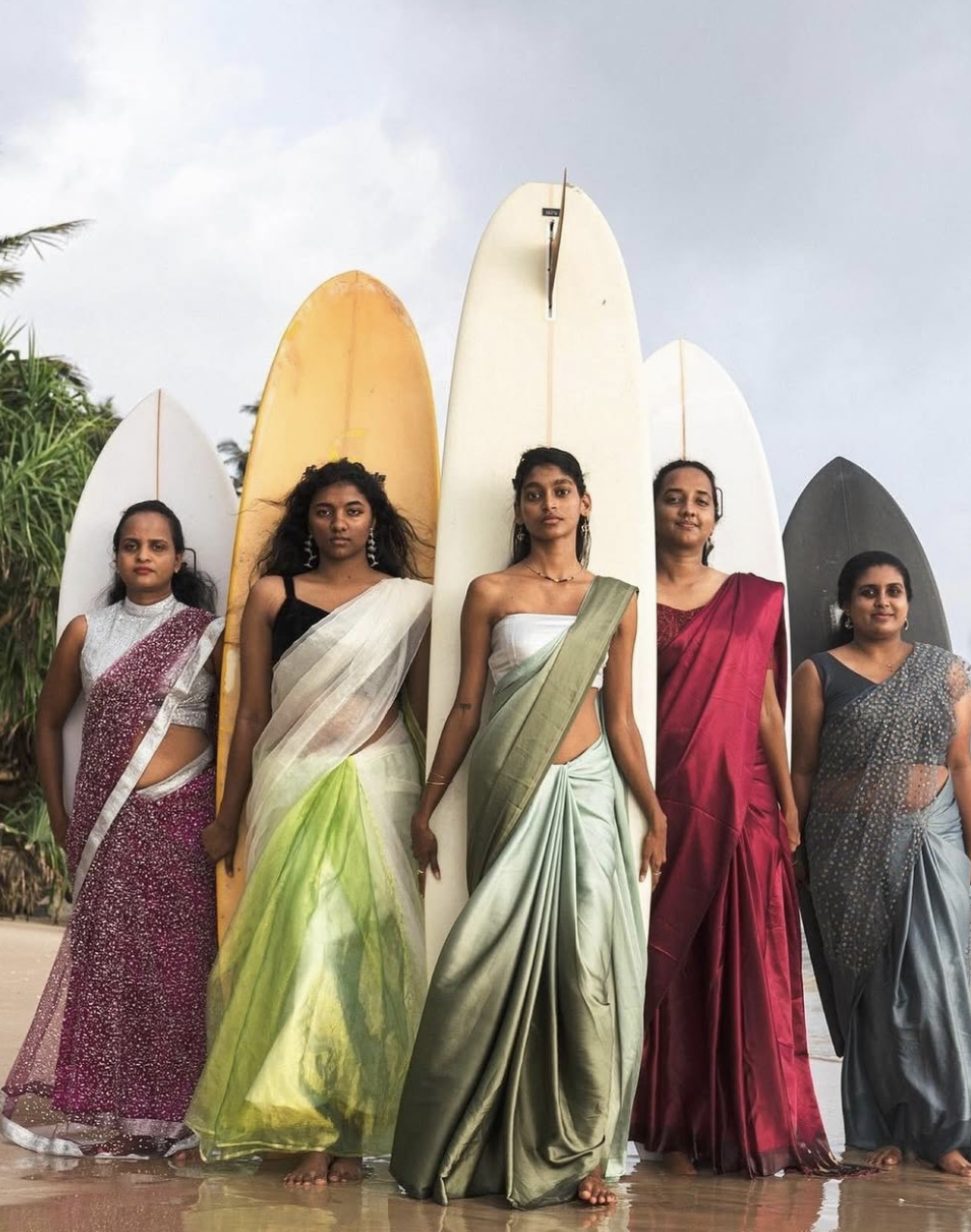
SeaSisters is a Sri Lankan organization that is teaching girls and women in Sri Lanka how to surf for free. Despite this being an island country, most women are hardly seen in the ocean and are often excluded from recreational and economic opportunities of surf tourism. SeaSisters is an excellent example of quiet rebellion, where instead of expending energy protesting against cultural expectations, they’re unobtrusively disengaging and creating their own pathway instead. Women are invited to participate and empowered to live fully, resulting in greater confidence, a renewed sense of joy and delight, and access to paid roles within the surfing industry.
Climavore’s Water Buffalo Festival is another example. Wetlands, marshes, and mangroves are essential for biodiversity and their role in buffering against flooding, and in Turkey, water buffalo play an important part in naturally maintaining these areas, alongside preventing invasive species. Despite this, wetlands have notoriously been drained for centuries to bolster monoculture farmland and real estate development. Rather than going the traditional activism route of lobbying for wetland protection or staging protests, Climavore leaned on ritual and celebration as a way of marrying ecological policy with culture. The Water Buffalo Festival they created ushered in real change, through joy. The festival divests away from the urgency rhetoric of the climate justice movement, and chooses to address it through slowness and seasonality instead. It takes place-based community development into account where roaming populations and herders can remain empowered, recognized, and in place. It decenters human mastery, understanding that coexistence with our more-than-human counterparts is how we practice true relationality and regeneration, and it promotes historic buffalo milk dishes to highlight the diverse foodscape of the city’s green belt. In a genius move, Climavore successfully and discreetly disarmed opposition, and created change through delight and a sense of shared history.
In 2026 and beyond, we’ll see more examples of how real change is being created through acts of joy, care-based resistance, quiet rebellions, shared cultural preservation, and insightful creativity, where we finally understand the power of reciprocity and relationality.
5. Intentional Itineraries
With a vested interest in land-based experiences and how we personally and collectively relate to place, the changes happening in the travel sector feel especially significant to me.
In 2026 and beyond, travel becomes less about escaping, and more about intentionally moving towards, and this can be seen in the subtle shifts that are already underway.
In this trend, I’ll be linking together an Irish psychologist’s mythic imaginings, an emerging definition of luxury, and insights from my own lived experiences.
In her book, The Enchanted Life, writer and mythologist Sharon Blackie reminds us that we are not separate from the landscapes that call to us, rather we are landscapes ourselves. She suggests that part of finding our place in the world is understanding which topographies we resemble, and which ones we are craving in this season of life. For example, if you’re feeling called to a shoreline, you may be needing liminality, spaciousness, and flow. Desiring a mountain landscape may speak to a greater need for perspective and air. Seeking a forest terrain may point to a deep need for enclosure, safety, peace, and groundedness. This somatic relationship to environment can also be seen through Human Design, as we each have our personal environmental landscapes that physically and energetically map us.
In 2026, travel will increasingly be shaped by this inner orientation, and rather than asking where we should go, we’ll be tuning into where we feel regulated, restored, and pulled towards. The rise of slower travel, rural stays, and seasonal migration reflects a wider cultural shift, where travel becomes a practice of self-attunement, rather than an accumulation of site-seeing and bucket list checkmarks.
As mentioned in the Time to Go trend, off-season travel and calendar-free roaming mirror a deeper alignment with personal rhythm. In parallel, travellers are returning to the same places again and again, cultivating a sense of intimacy and knowing. This shift reflects a growing desire for relationship with place, where landscape, story, atmosphere, and emotion take precedence over amenities or scale. Travel is no longer about going somewhere because it’s trending, but more about how a place meets you, holds you, and makes you feel, where it becomes so aligned with our personal wellbeing and needs.
With that in mind, travel is also becoming more interest-focused, where we’re traveling for really specific experiences, in lieu of must-see lists that now feel stale and overdone.
A music festival with your favourite artists headlining that just happens to be in Cancun? Tickets booked. An author you stan is having their book launch in Ibizia? Spain incoming. A beloved contemporary artist is popping up in Dubai? Done. With travel becoming simultaneously more accessible and less novel, we’re seeking experiences that speak to us, and that blend interests, place, and uniqueness for a new take on originality.
This shift sits in direct conversation with the redefinition of luxury. Where luxury once implied floating above reality, insulated from inconvenience, friction, and the messiness of everyday life, it is now, ironically, moving in the opposite direction.
Today, as life is inundated with all things digital, value is shifting towards what cannot be replicated online (as discussed in the Analog Artistry trend).
Luxury is no longer about escape from reality, but rather a participatory and immersive relationship.
Examples include choosing accommodations that require a walk, boat ride, or hike to reach, off-grid properties located deep in nature, architecture that highlights local building methods rather than global luxury codes, meals cooked over a fire, eaten communally, or sourced entirely from the land, experiences that teach traditional crafts, farming practices, or food preparation, and accommodations where staying with land stewards, guides, or cultural hosts surpass the anonymity of sleek hotels.
Grit, texture, effort, and sensation are emerging as the new markers of luxury, and what was once optimized out is now being sought after.
These 5 emerging trends are not isolated from one another but rather interwoven, each enriching the other to shape a more thoughtful and regenerative future.
A main theme throughout this report is centered around the redistribution of friction. Analog Artistry celebrates friction as actualized through our need for tangibility and the reclamation of our cultural sphere, whereas Culture Reimagined demonstrates that in lieu of protests and charged activism, creativity, delight, and quiet rebellion can be impactful, frictionless tools towards revolutionary change. Time to Go shows us what a frictionless world can look like at the structural level, where we embrace optimization in infrastructure, transit, and movement, whereas Intentional Itineraries demonstrates that reintroducing friction at the embodied level is what makes the experience of being on Earth pleasurable. Embodied Energy holds both with complexity, as in order to reach a level of embodiment, we must first go through the friction of our limitations. The throughline of embraced duality is ripe throughout this report - analog and tech, effort and ease – demonstrating that the futures we dream of are indeed ancestrally emergent.